Man-to-Man or Zonal Marking: Two Ways to Defend Space
Man-to-man or zonal marking shapes who tracks a runner and who protects space. Learn to read defensive movement, handoffs and team shape as play unfolds.

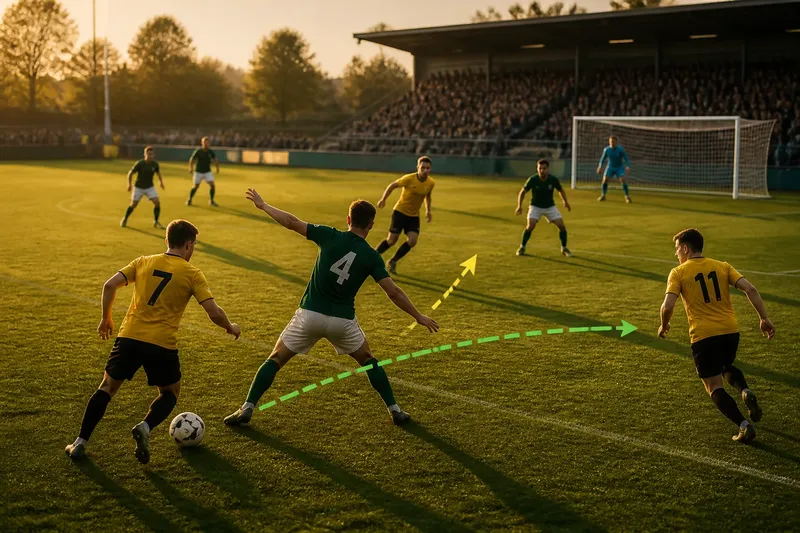
A winger drifts away from the touchline, and the defender tracking her must decide whether to follow. That moment helps distinguish man-to-man or zonal marking: one approach puts more emphasis on an assigned opponent, while the other puts more emphasis on a protected area. Teams often blend the two, so a single movement is a clue, not a complete diagnosis.
These are ways of assigning defensive responsibility, not fixed shapes or guarantees of success. A team can defend man-to-man across the pitch, use zones near its own goal, or combine the approaches. To understand what you are watching, follow the defender’s decision rather than guessing from the formation.
What does man-to-man marking ask a defender?
In man-to-man marking, a defender is responsible for an assigned opponent. If that player moves, the defender generally adjusts to stay close enough to challenge, block a pass or prevent a turn. The assignment may apply within a particular area or continue as the opponent travels farther across the field.
“Man” is traditional shorthand: the assignment can be on any opponent. Coaches may pair defenders with forwards or assign a midfielder to an opposing playmaker. The defining feature is that responsibility follows a player more than it belongs to a patch of grass.
This can crowd an opponent’s options. A receiver may find a defender close when the ball arrives, and a team can disrupt passing patterns by staying attached to players who would normally connect them. The defender still has to judge how tightly to follow without losing sight of the ball or nearby threats.
Close tracking can pull a defender out of a useful position. If an opponent runs toward the sideline or into a deeper area, following may open a lane for another attacker. Defenders therefore need to communicate about exchanges: one player may pass the runner to a teammate rather than chase across the whole formation.
What does zonal marking ask a defender?
In zonal marking, each defender protects an area and reacts to threats entering it. The defender’s first question is less “Which player is mine?” and more “Who is entering my space, and what can they do from here?” A teammate takes responsibility when an attacker moves into another zone.
Zones are not necessarily painted boundaries. They are practical areas shaped by the ball, teammates and opponents. A defender may step forward to challenge a receiver, drop back to protect space behind, or hold position while a teammate deals with an attacker elsewhere.
This approach can help a team preserve its overall shape. Defenders can remain connected, cover dangerous lanes and avoid being dragged far apart by decoy runs. But a zone does not defend itself: if players are slow to recognize a threat or unclear about who will challenge, an opponent may receive unopposed in a useful pocket.
Zonal defending asks players to scan continuously. They need to notice the ball, runners crossing their area and spaces that may open if they step out. A defender watching only the nearest opponent can miss a second attacker arriving behind that player.
How do the approaches affect team shape?
Man-to-man marking tends to make the defensive shape responsive to opponents’ movements. A defender may leave the line to track a forward, and another defender may have to cover the space left behind. If several assignments pull players in different directions, the team can become stretched or uneven.
Zonal marking tends to preserve relationships between teammates. Players move as a connected unit, shifting toward the ball while retaining cover across nearby areas. This can make it harder for attackers to find open lanes, although an opponent may still exploit a gap if defenders shift late or fail to hand over a runner.
Neither description means one system always produces a neat shape and the other always produces disorder. A well-organized man-marking team can coordinate its assignments, while a zonal team can lose structure through hesitation. The useful distinction is what prompts a defender’s movement: an opponent’s route, a threat entering an area, or a mixture of both.
Say a midfielder moves from the center toward the right channel while a forward runs into the space behind him. In this invented situation, a man-marking plan could have the midfielder’s marker follow, leaving a teammate to cover the forward’s run; the observable result would be one defender moving wide and another taking the exposed lane. A zonal plan could instead have the central defender stay in position and challenge the forward, while a teammate adjusts toward the midfielder; the result would be a handoff rather than one defender following the same opponent throughout. Which response is better depends on the team’s plan and the immediate danger.
Where do teams combine man-marking and zones?
Many defensive plans combine the approaches because different situations create different responsibilities. In open play, a team may use zones to protect central space but ask a nearby defender to track a dangerous runner. On a corner, defenders may guard particular opponents while teammates protect areas where a cross could land.
These combinations are often called hybrid marking. The label matters less than the handoff: defenders need to know when an assignment ends, who accepts the next threat and which space still needs cover. Without shared understanding, one player can assume a teammate has taken responsibility when neither has.
Set pieces make the contrast especially visible. In a zonal arrangement, defenders position themselves around areas near the goal and challenge for the ball if it enters their zone. In a man-marking arrangement, defenders stay with assigned opponents as they move; a mixed plan can use both, with some players tracking attackers and others guarding likely landing areas.
There is little value in identifying a system from a single snapshot. Watch what happens when an attacker crosses paths with another player, moves beyond a defender’s area or runs away from the ball. Those moments reveal whether the original defender follows, hands the opponent over or stays in place.
How can you read man-to-man or zonal marking?
Does the defender follow an opponent away from the ball?
If the defender continues tracking that player into a different area, the team may be using man-to-man responsibility. Check whether a teammate shifts to cover the space left open, since organized tracking often depends on that support.
Does the defender hold position as a runner passes?
A defender who stays in an area while a teammate takes the runner may indicate zonal responsibility or a planned handoff. Look for whether the team keeps its spacing and whether the next defender clearly engages the attacker.
What happens when two attackers cross paths?
In man-to-man marking, defenders may follow their assigned players through crossing routes, or exchange assignments if that is part of the plan. In zonal marking, each defender usually responds to the attacker entering the area, so the players being tracked can change as movement unfolds.
What happens when the ball moves to a new side?
A zonal defense commonly shifts together toward the ball while covering nearby lanes. A man-marking defense may also shift, but a useful clue is whether individual defenders keep following their assignments as the ball travels elsewhere.
What is each approach trying to protect?
Man-to-man marking prioritizes pressure on specific opponents. It can be useful when a team wants to limit a particular player’s influence or prevent comfortable receptions. The trade-off is that defenders must manage runs and coordinate cover so close attention to one opponent does not leave another threat free.
Zonal marking prioritizes control of space and the relationships between defenders. It can help a team protect central routes and stay compact, especially when attackers move often or exchange positions. Its trade-off is that defenders must recognize when a threat becomes urgent and step out decisively rather than waiting for someone else.
Not every opponent needs the same response. A team may track a creative midfielder closely while keeping the rest of its block zonal, or use individual assignments only during a set piece. The choice depends on players’ roles, the threats to manage and how well teammates can communicate their responsibilities.
What is not worth over-reading?
A team’s formation graphic does not reveal its marking method. Two teams listed in the same formation can defend differently, and one team can change its assignments between open play, pressing situations and dead-ball restarts.
It is also not useful to call every defender who follows an opponent “man-marking.” A zonal defender may briefly track a runner to prevent an immediate threat, then hand that player over. Look for the repeated pattern across several movements, not one chase or pause.
For man-to-man or zonal marking, the most informative question is why the defender moved. If movement follows an opponent, individual responsibility is driving the action; if it responds to a threat entering an area, space is driving it. Watch the handoffs as well as the challenges: they show whether the team’s plan is shared and where an opponent might find room.